


Note
Go to the end to download the full example code.
Subject level analysis with resampling#
This tutorial introduces how to use pycrostates.preprocessing.resample
to compute individual microstate topographies and study the stability of
the clustering results.
Note
The lemon datasets used in this tutorial is composed of EEGLAB files. To
use the MNE reader mne.io.read_raw_eeglab(), the pymatreader
optional dependency is required. Use the following installation method
appropriate for your environment:
pip install pymatreaderconda install -c conda-forge pymatreader
Note that an environment created via the MNE installers includes
pymatreader by default.
import numpy as np
from matplotlib import pyplot as plt
from mne.io import read_raw_eeglab

from pycrostates.cluster import ModKMeans
from pycrostates.datasets import lemon


raw_fname = lemon.data_path(subject_id="010017", condition="EC")
raw = read_raw_eeglab(raw_fname, preload=True)
raw.crop(0, 60)
raw.pick("eeg")
raw.set_eeg_reference("average")
/home/docs/checkouts/readthedocs.org/user_builds/pycrostates/checkouts/main/tutorials/cluster/10_subject_level_with_resampling.py:35: RuntimeWarning: Limited 1 annotation(s) that were expanding outside the data range.
  raw = read_raw_eeglab(raw_fname, preload=True)
/home/docs/checkouts/readthedocs.org/user_builds/pycrostates/checkouts/main/tutorials/cluster/10_subject_level_with_resampling.py:35: RuntimeWarning: The data contains 'boundary' events, indicating data discontinuities. Be cautious of filtering and epoching around these events.
  raw = read_raw_eeglab(raw_fname, preload=True)
Resampling is a technique which consist of selecting a subset from a
dataset several times. This method can be useful to study the stability and
reliability of clustering results. In this example, we will split our data in
n_resamples resamples each containing n_samples randomly selected
from the original recording.
Note
This method can also be used on GFP peaks only!
We can compute the cluster centers on each of the resample and plot
the topographic maps fitted on a unique figure with the axes argument.
f, ax = plt.subplots(nrows=len(resamples), ncols=5)

resample_results = []
for k, resamp in enumerate(resamples):
    # fit Modified K-means
    ModK = ModKMeans(n_clusters=5, random_state=42)
    ModK.fit(resamp, n_jobs=2, verbose="WARNING")
    resample_results.append(ModK.cluster_centers_)
    # plot the cluster centers
    fig = ModK.plot(axes=ax[k, :])
    plt.text(
        0.5,
        1.4,
        f"GEV: {ModK.GEV_:.2f}",
        horizontalalignment="center",
        verticalalignment="center",
        transform=ax[k, 2].transAxes,
        fontdict=dict(size=14),
    )

plt.subplots_adjust(top=0.9, hspace=0.5)
plt.show()
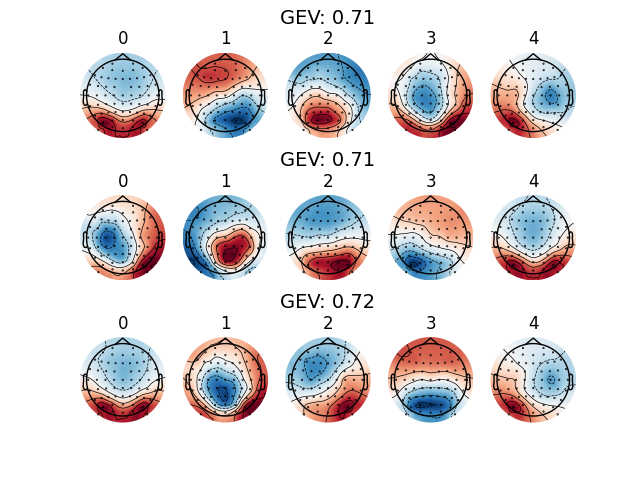
Each resampling clustering solution explains about 70% of its Global Explained Variance (GEV). We can distinguish similar topographies between fits, although with large variation, different signs and in a different order. The sparsity of results reveals how data sampling may influence the results of microstates analysis. Sampling issues are inherent to EEG recording: recording are conducted at a specific time a specific day, in specific condition and have a finite duration.
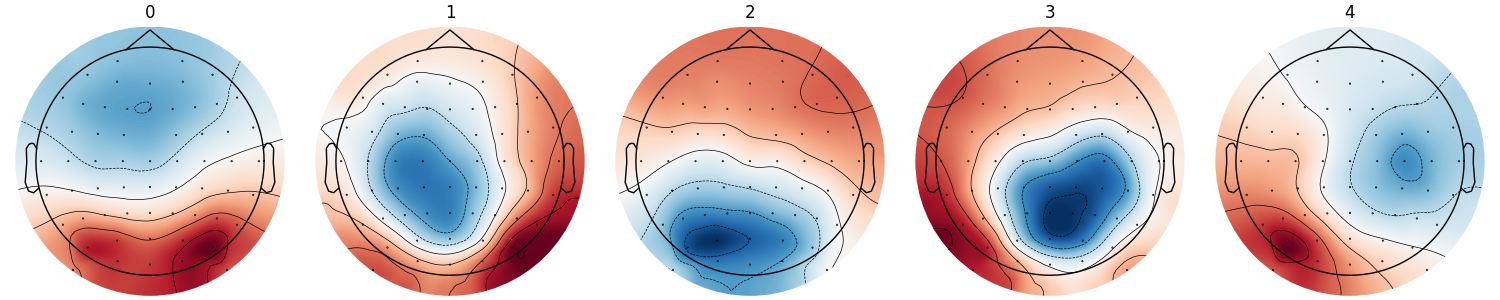
To improve the stability of the clustering, it is possible to compute a second clustering solution on the concatenated cluster centers fitted on the resample datasets.
from pycrostates.io import ChData

all_resampling_results = np.vstack(resample_results).T
all_resampling_results = ChData(all_resampling_results, raw.info)

ModK = ModKMeans(n_clusters=5, random_state=42)
ModK.fit(all_resampling_results, n_jobs=2, verbose="WARNING")
ModK.plot()
<Figure size 1500x300 with 5 Axes>
Note
This method can also be applied for group level analysis by mixing individual resampling results together.
Total running time of the script: (0 minutes 6.439 seconds)
Estimated memory usage: 214 MB